
The 12 Qi Phases in BaZi: From Birth to Storage
Everything in nature passes through the same stages: emergence, growth, flourishing, aging, and fading away. Chinese masters noticed that each of the ten Heavenly Stems behaves in the same way. As a Stem encounters different Earthly Branches, it gains or loses strength. This cycle is called the twelve qi phases (十二運, shi er yun). Let’s explore what these phases are and how they help us understand the strength of the elements in a BaZi chart.
What are qi phases?
Qi phases describe the relationship between a Heavenly Stem and an Earthly Branch. If you take any Stem and follow it through all twelve Branches, it will pass through a complete life cycle—from conception to extinction. The Chinese compare this both to human life and to the life of a plant: seed, sprout, young plant, flowering, fruit, and withering.
The twelve phases
| No. | Phase | Chinese name | Meaning | Strength |
|---|---|---|---|---|
| 1 | Embryo (Conception) | 胎 | A new life has only just been conceived | Moderate |
| 2 | Nourishment | 养 | Strength accumulates, as in a child before birth | Moderate |
| 3 | Growth and Development (Birth) | 长生 | Rapid growth without limitations | Very strong |
| 4 | Bath (Dirty Water) | 沐浴 | Skills are present, but experience is lacking; guidance is needed | Very weak |
| 5 | Cap and Belt | 冠带 | Maturing, learning, receiving initial guidance | Strong |
| 6 | Taking Office | 临官 | Entering the world, taking on initial responsibilities and a profession | Strong |
| 7 | Imperial Prosperity | 帝旺 | The peak of strength and maturity | Very strong |
| 8 | Decline | 衰 | Strength remains, but growth has stopped | Moderate |
| 9 | Illness | 病 | Energy diminishes | Moderate |
| 10 | Death | 死 | Movement ceases | Weak |
| 11 | Grave (Storage) | 墓 | Everything retreats inward and is preserved | Very weak |
| 12 | Extinction | 绝 | The complete end of the cycle before a new conception | Very weak |
Dr. Manfred Kubny, a German sinologist and one of Europe’s leading BaZi experts, divides the phases into five groups according to strength. The strongest are Growth and Development and Imperial Prosperity. The weakest are Bath, Grave, and Extinction.
Where each Stem begins to grow and reaches its peak
To find a phase, you need to know in which Branch the Stem enters Growth and Development, then count through the phases in order. For Yang Stems, the phases move forward around the cycle of Branches; for Yin Stems, they move backward.
| Stem | Growth and Development | Imperial Prosperity | Grave |
|---|---|---|---|
| 甲 Yang Wood | 亥 Pig | 卯 Rabbit | 未 Goat |
| 乙 Yin Wood | 午 Horse | 寅 Tiger | 戌 Dog |
| 丙 Yang Fire | 寅 Tiger | 午 Horse | 戌 Dog |
| 丁 Yin Fire | 酉 Rooster | 巳 Snake | 丑 Ox |
| 戊 Yang Earth | 寅 Tiger | 午 Horse | 戌 Dog |
| 己 Yin Earth | 酉 Rooster | 巳 Snake | 丑 Ox |
| 庚 Yang Metal | 巳 Snake | 酉 Rooster | 丑 Ox |
| 辛 Yin Metal | 子 Rat | 申 Monkey | 辰 Dragon |
| 壬 Yang Water | 申 Monkey | 子 Rat | 辰 Dragon |
| 癸 Yin Water | 卯 Rabbit | 亥 Pig | 未 Goat |
For example, Yang Wood 甲 is born in the Pig (亥), reaches its peak in the Rabbit (卯), and enters storage in the Goat (未). Yin Wood 乙, by contrast, is born in the Horse (午) and reaches its peak in the Tiger (寅).
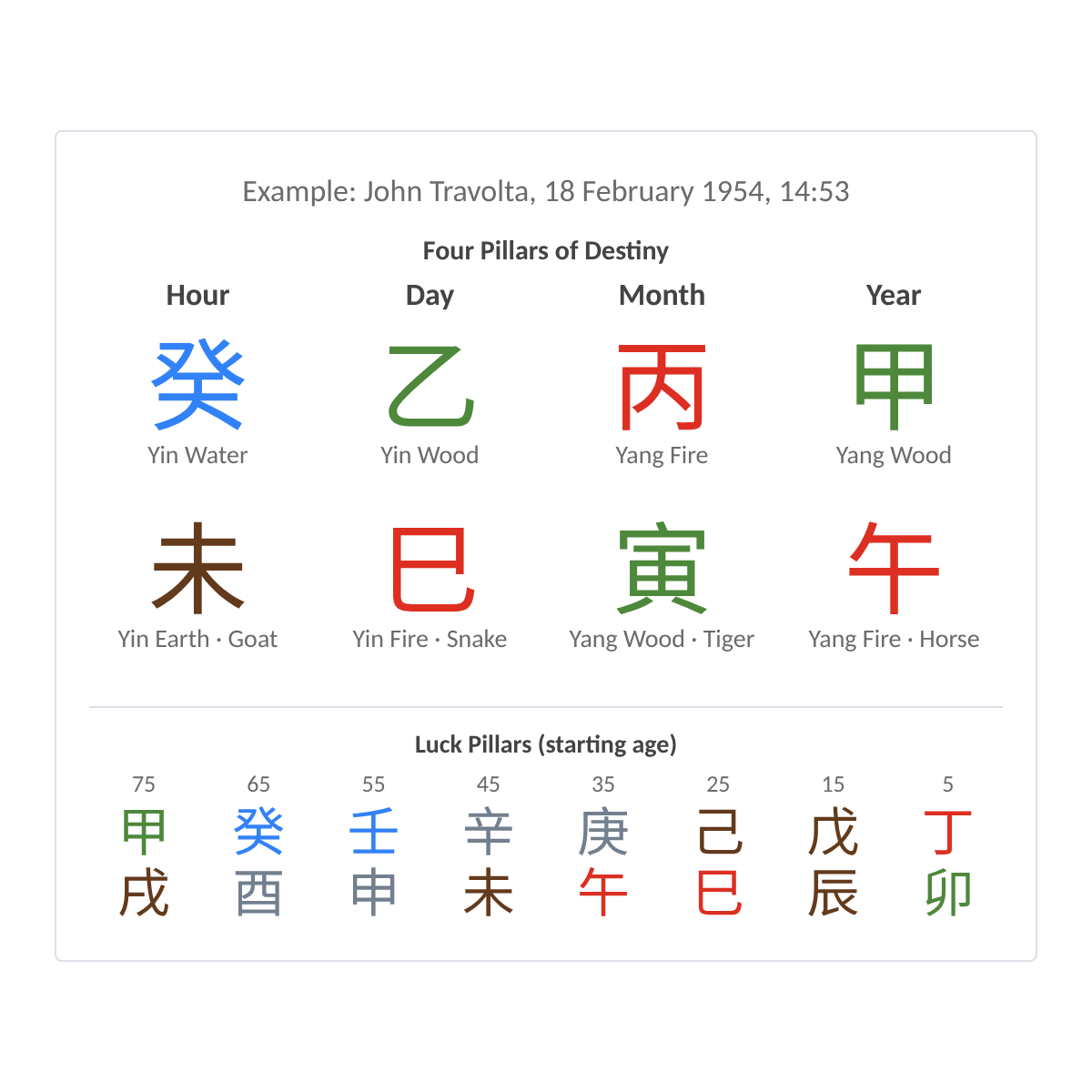
Example: John Travolta and Elon Musk
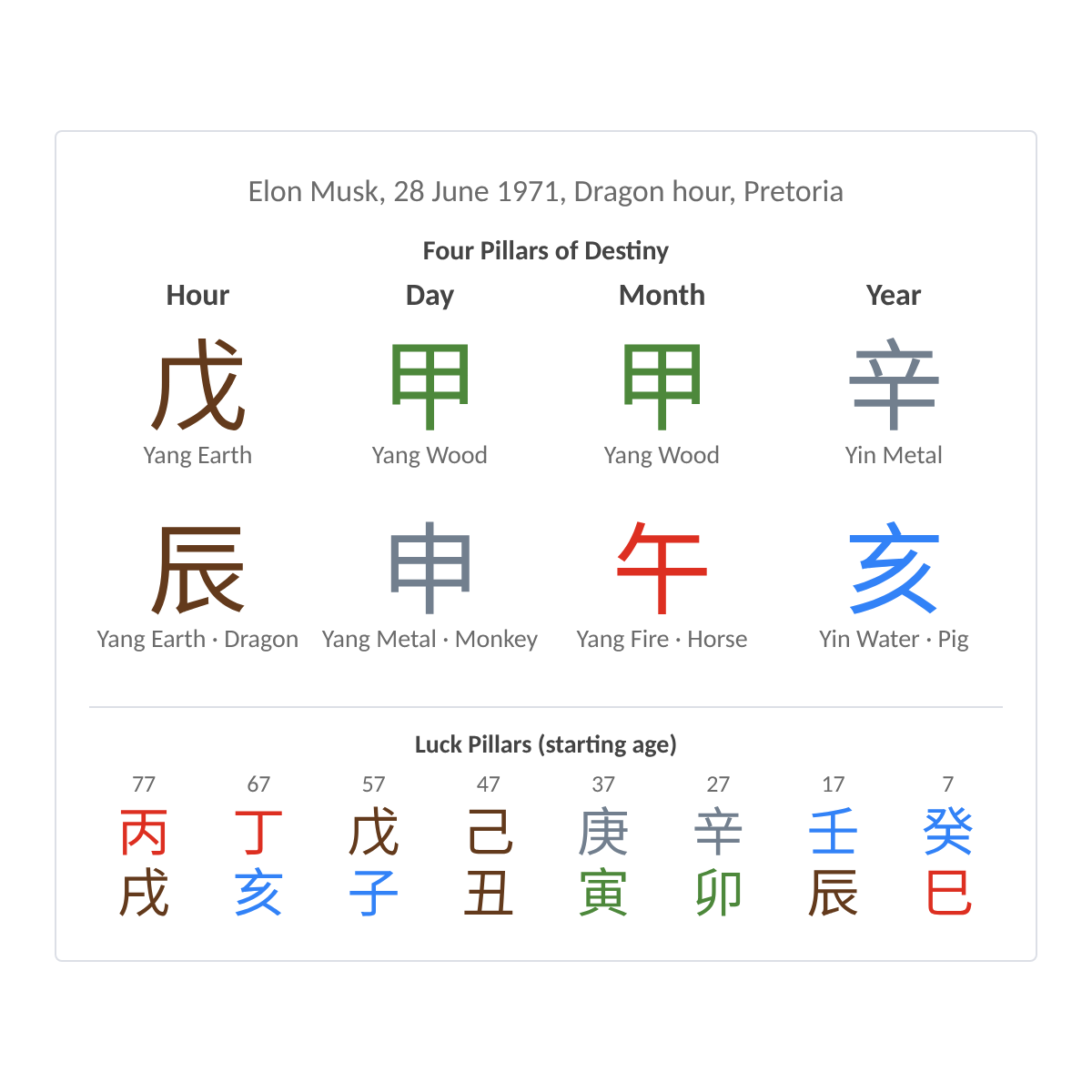
Both have Wood as their Day Master, but their qi phases place them at opposite ends of the cycle.
John Travolta has Yin Wood 乙 as his Day Master and was born in the Month of the Tiger 寅. For 乙, the Tiger is the Imperial Prosperity phase: spring, the very peak of Wood’s strength.
Elon Musk has Yang Wood 甲 as his Day Master and was born in the Month of the Horse 午. For 甲, the Horse is the Death phase: in summer, Wood spends its strength feeding Fire. His Day Branch, the Monkey 申, is even in the Extinction phase. But there is support as well: his Year Branch, the Pig 亥, is the Growth and Development phase for 甲, and a second 甲 appears in the Month Stem. This clearly shows that a weak phase is not a verdict: it simply means that the Day Master’s strength must be sought in other parts of the chart.
How qi phases are used in chart analysis
- The strength of the Day Master. What matters most is the phase of the Day Master in the Branch of the birth month—that is, in its season. Wood born in spring in its peak phase is much stronger than Wood born in autumn in the Death phase.
- The strength of the other elements. Any Stem in the chart can be assessed in the same way: does it sit on a strong Branch or a weak one?
- Luck Pillars and years. When a Luck Pillar or year brings a Branch in which your Day Master is in a strong phase, you feel a surge of energy. A weak phase is a time when it is better to conserve resources.
Qi phases are a supplementary tool. They do not replace an overall assessment of the chart’s strength, but help make it more precise.
Qi phases and date selection
The Branch of each day also places your Day Master in a particular phase. But other factors matter more for date selection: whether the day clashes with your Branches and whether it brings useful elements. This is taken into account in your personal stars by date of birth and in the Personal Calendar. To see your Stems and Branches, generate your chart in the BaZi calculator.
Frequently asked questions
Is the “Death” phase in a chart dangerous?
No. The phase names are figurative: “Death” simply means that the element is weak in that Branch. The name of the phase does not directly refer to life events.
Why do the phases move backward for Yin Stems?
This is the convention in the classical system: Yin and Yang mirror each other, and when a Yang Stem gains strength, the Yin Stem loses it. Some schools use the same sequence for Yin Stems as for Yang Stems, so different tables appear in books.
Do I need to memorize the phases?
To begin with, it is enough to remember where your Day Master enters Growth and Development and Imperial Prosperity. The rest can easily be counted around the cycle.
Views: 1