Indirect Wealth in BaZi: The Entrepreneur and Risk
Indirect Wealth is the most beloved sign in China. Many see it as a promise of easy money. But like Direct Wealth, this sign does not guarantee riches: it describes a particular talent—the ability to find money where others see none.
How to find Indirect Wealth
Wealth is the element controlled by your Day Master. Indirect Wealth (偏財, pian cai) is Wealth of the same polarity. For Yang Water 壬, it is Yang Fire 丙; for Yin Metal 辛, it is Yin Wood 乙. Literally, 偏財 means “indirect wealth.” The character 偏 suggests a slope or incline down which something can roll: the person seems to “roll” toward money. Another name for this sign is 利事, “profitable business.”
How it differs from Direct Wealth
Direct Wealth is what already belongs to a person. Indirect Wealth is money that “circulates” within a group of people and belongs to no one in particular. You can attract it, but only through your own skills. This is therefore not a salary, but performance-based work with bonuses, your own business, or investment income.
The character of a person with Indirect Wealth
- Quickly understands how money and influence move within a group and who is in charge;
- Knows how to be in the right place at the right time;
- Knows what is currently popular and what can be sold at a profit;
- Sociable, active, and good at working with others;
- Readily takes risks: they have nothing to lose and everything to gain.
For such a person, gain means not only money but also recognition, fame, and social standing.
Why Indirect Wealth needs Output
Indirect Wealth only truly works when the chart contains Output—Eating God or Hurting Officer. Output produces Wealth: wanting profit is not enough for an entrepreneur; they need energy, ideas, and a desire to express themselves. And, of course, the Day Master must be strong enough to hold on to the money.
Example: Elon Musk’s chart
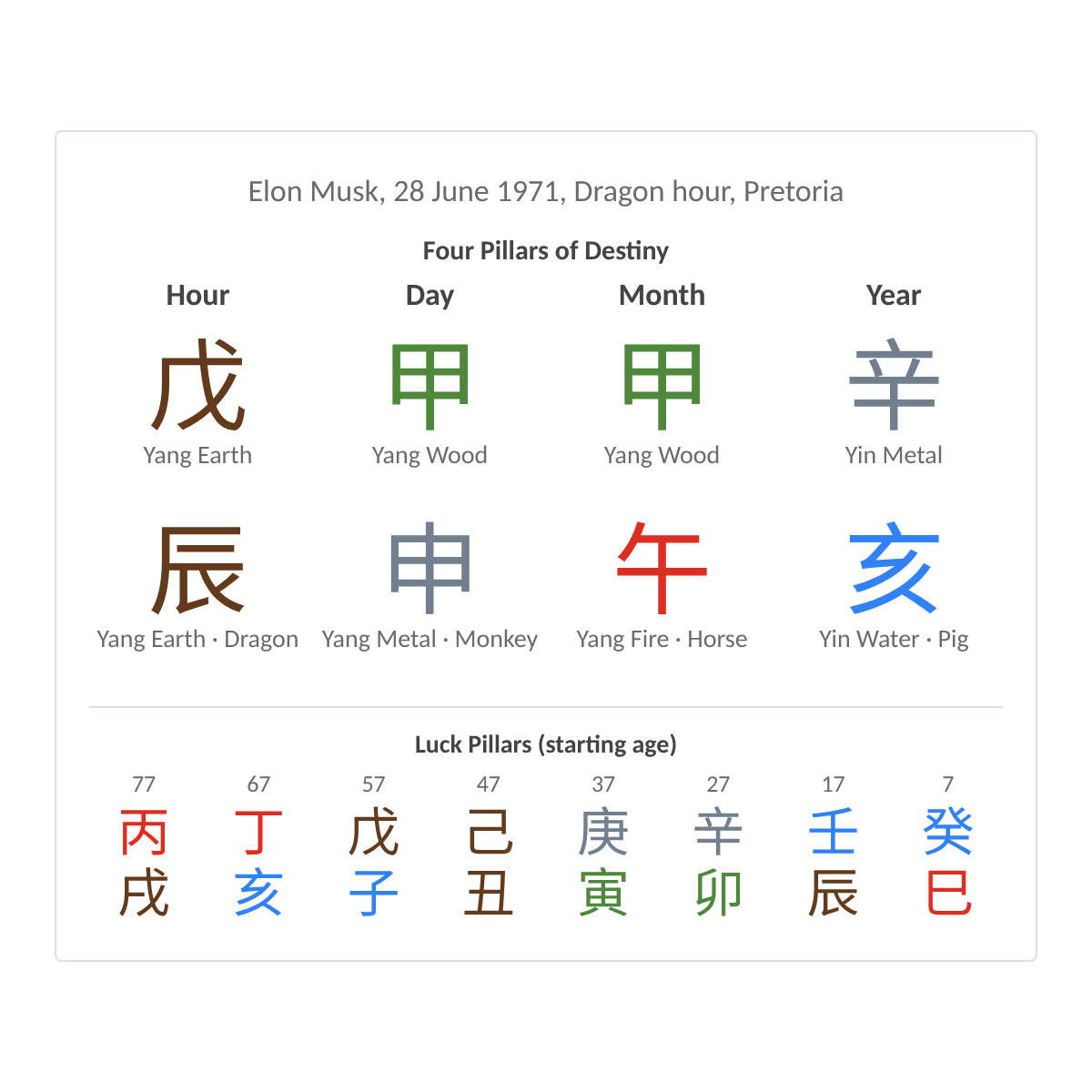
Elon Musk was born on June 28, 1971, in Pretoria in the Hour of the Dragon. His Day Master is Yang Wood 甲, and his Wealth is Earth. His entire Hour Pillar is Yang Earth: the Stem 戊 and the Dragon Branch 辰. This is pure Indirect Wealth, with the same polarity as the Day Master. And it has a source of nourishment: his Month Branch is the Horse 午—Fire, or Output, which for 甲 is Hurting Officer. Fire produces Earth, and ideas turn into money—exactly the sequence described above. A second 甲 Stem in the Month Pillar supports the Day Master. Risky projects, running a business rather than earning a salary, and betting on things that do not yet exist—this is a classic portrait of a person with Indirect Wealth.
Men and Indirect Wealth
In a man’s chart, Wealth also represents women. Direct Wealth represents a wife; Indirect Wealth represents a girlfriend or romantic interests. This is not a verdict, merely an indication of temperament.
Indirect Wealth and date selection
Days that bring your Indirect Wealth are good for negotiations, sales, launching a project, and investments—if Wealth is useful to you and your Day Master is strong enough. This can be seen in your BaZi chart: generate it in the BaZi calculator, then look for suitable days in the Personal Calendar and the auspicious date search.
Frequently asked questions
Does Indirect Wealth mean a love of gambling?
In part. It is a willingness to take risks for gain. If the Day Master is weak, risk can lead to losses, which is why the whole chart matters.
Which is better: Direct Wealth or Indirect Wealth?
Neither is better. They are two different ways of earning money: one stable, the other entrepreneurial.
Views: 1