
The Ten Gods of BaZi: What They Are and How to Find Them in Your Chart
When reading a BaZi chart interpretation, you often encounter unusual names: “Rob Wealth,” “Eating God,” and “Seven Killings.” These are known as the Ten Gods, deities, or spirits of BaZi. It sounds mystical, but BaZi is not a religion, and there are no actual gods involved. The Ten Gods are ten types of relationships between the Day Master and the other signs in the chart—and, through these relationships, ten types of character and behavior.
Where the Ten Gods come from
Every sign in the chart is read in relation to the Day Master—the Heavenly Stem of the birth day. Five aspects of life are connected with it: Friends, Output, Wealth, Power, and Resources. Each aspect comes in two forms, depending on whether the sign has the same Yin–Yang polarity as the Day Master. Five aspects multiplied by two give us the Ten Gods.
| Relationship to the Day Master | Same polarity | Opposite polarity |
|---|---|---|
| The same element | Friend (比肩) | Rob Wealth (劫財) |
| Produced by the Day Master | Eating God (食神) | Hurting Officer (傷官) |
| Controlled by the Day Master | Indirect Wealth (偏財) | Direct Wealth (正財) |
| Controls the Day Master | Seven Killings (七殺) | Direct Officer (正官) |
| Produces the Day Master | Indirect Resource (偏印) | Direct Resource (正印) |
Different books translate these names differently. Rob Wealth is also called “Friends of the Opposite Polarity,” Eating God is called “Regular Output,” and Indirect Wealth is called “Unexpected Money.” The meaning remains the same.
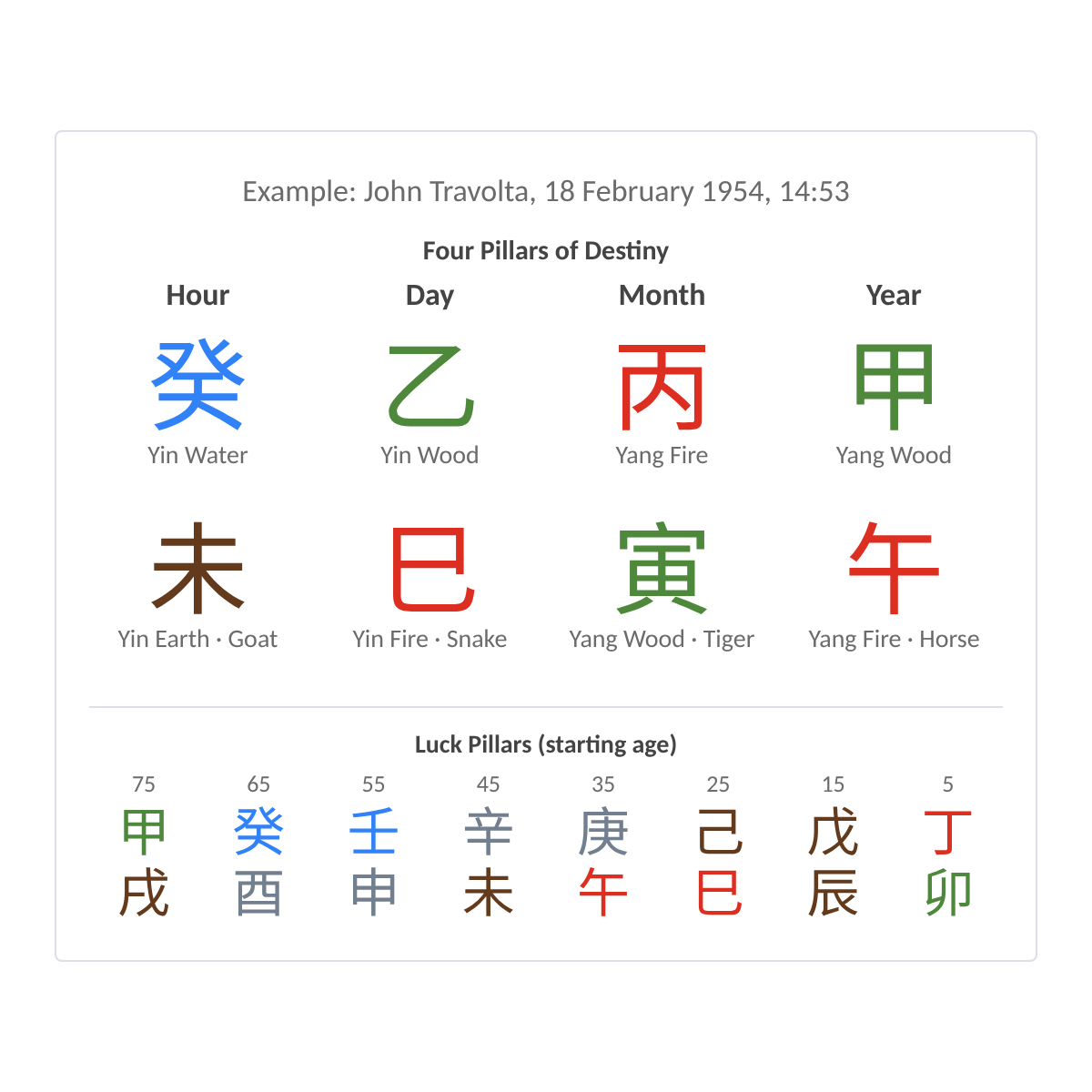
Example: John Travolta’s chart
Travolta’s Day Master is Yin Wood 乙. His Year Pillar contains Yang Wood 甲: the same element with the opposite polarity—Rob Wealth. His Month Pillar contains Yang Fire 丙: Wood produces it, and the polarity is different—Hurting Officer. His Hour Pillar contains Yin Water 癸: it nourishes Wood and has the same polarity—Indirect Resource. These three signs alone suggest a creative, independent person with an unconventional way of thinking.
Six Spirits and Four Helpers
In Chinese tradition, the Ten Gods are sometimes divided into two groups: the “Six Spirits and Four Helpers” (六神四輔). Dr. Manfred Kubny, one of Europe’s leading BaZi experts, explains it this way. Friend, Rob Wealth, Eating God, and Hurting Officer describe our individuality—what manifests within us in its own right. Wealth, Power, and Resources manifest only among people: money and status have meaning only in comparison with others.
Good and bad Gods?
The names may sound frightening, but there are no bad Gods. Seven Killings can make someone a courageous leader, while Direct Wealth can bring problems if the Day Master is too weak to hold on to it. Everything depends on the strength of the Day Master and which elements are useful to it. That is why a chart cannot be judged by a single sign.
The Ten Gods and date selection
Every calendar day also brings one of the Gods: for one person, it is a Wealth day; for another, a Power day. That is why the same date suits different people differently. On the site, dates are checked against your BaZi chart: generate it in the BaZi calculator, check your personal stars by date of birth, or open the Personal Calendar.
Frequently asked questions
Why are they called Gods if this is not a religion?
This is a literal translation of the Chinese terms. In terms of meaning, “types of energy” or “personality types” would be more accurate, but the words “deities,” “gods,” and “spirits” have become established in Russian-language books.
How many Gods can appear in one chart?
Besides the Day Master, a BaZi chart contains seven other signs—eight in total—plus the Hidden Stems within the Branches. A chart therefore usually contains several Gods: some repeat, while others are absent altogether.
Which matters more: the God or the element?
They are inseparable. A God is an element seen through the eyes of the Day Master. The same Metal is Power for Wood, but Resources for Water.
Views: 1