
Metal in BaZi: Yang and Yin Metal in the Chart
Metal is one of the five elements on which both BaZi and feng shui are based. In a BaZi chart, Metal can appear in the Heavenly Stems and the Earthly Branches, or it can be the Day Master—in which case it describes the person themselves. Let’s explore what Metal means in a chart, how its Yang form differs from its Yin form, and what it means when there is a lot or very little of this element.
Which signs belong to the Metal element?
Among the Heavenly Stems, these are 庚 Geng (Yang Metal) and 辛 Xin (Yin Metal). Among the Earthly Branches, they are 申 Monkey and 酉 Rooster. Generate your chart in the BaZi calculator, find these signs, and count how many times this element appears.
Yang and Yin forms
庚 Geng, Yang Metal is ore in the ground, raw, unworked metal. To extract it, the earth must be opened up, and to use it, it must be smelted. Yang Metal is therefore associated with change, strength, determination, and directness.
辛 Xin, Yin Metal is metal that has already passed through fire: jewelry, knives, fine wire. It is sharp, precise, and functional, so it is associated with efficiency, taste, elegance, and high standards.
Examples: Yang and Yin Metal
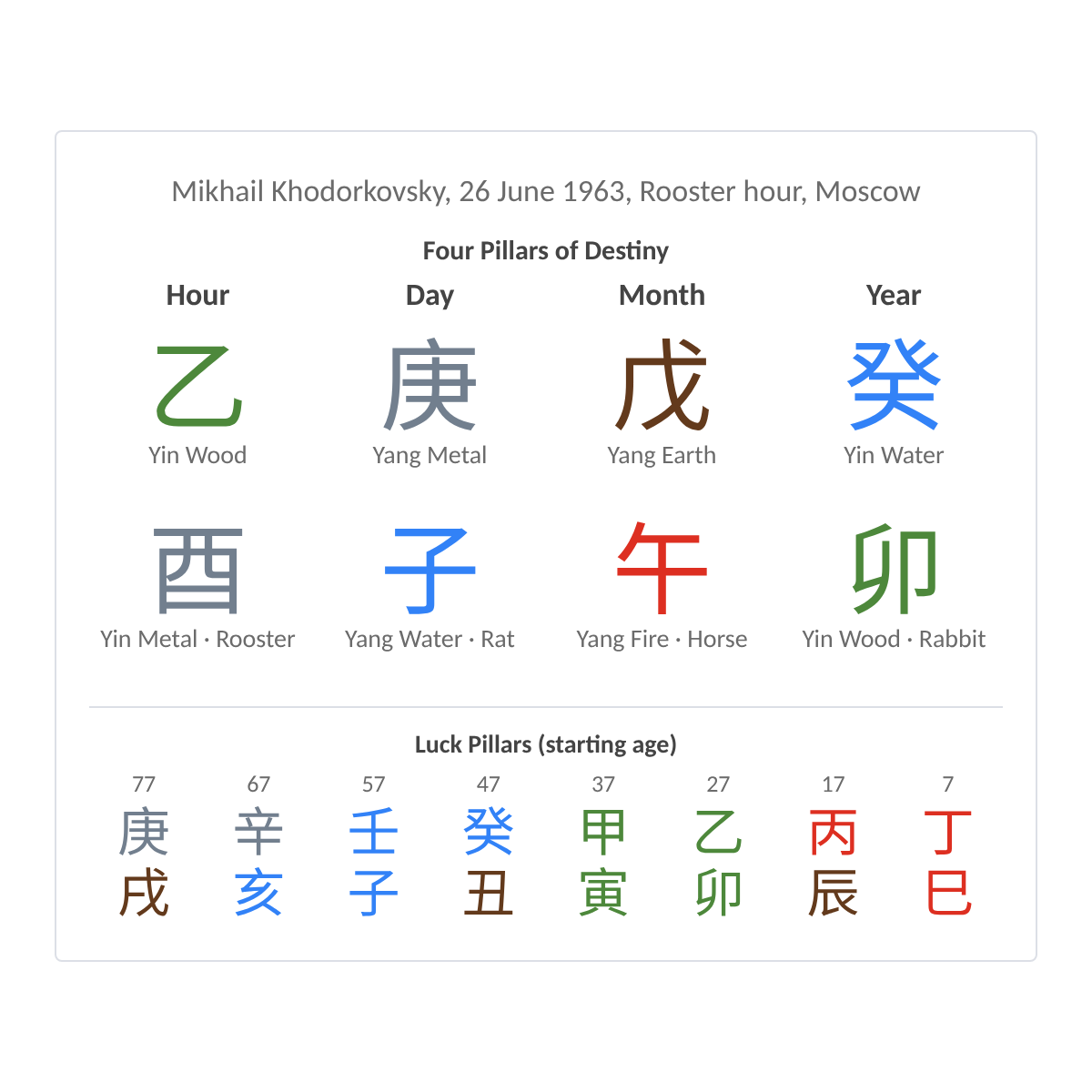
Yang Metal—Mikhail Khodorkovsky. The entrepreneur was born on a 庚子 day in the summer Month of the Horse and the Hour of the Rooster. Yang Metal is ore from which a sword is forged. The summer Fire of the month represents Power, which tempers Metal and puts pressure on it, while the Hour of the Rooster gives Metal a root and resilience.
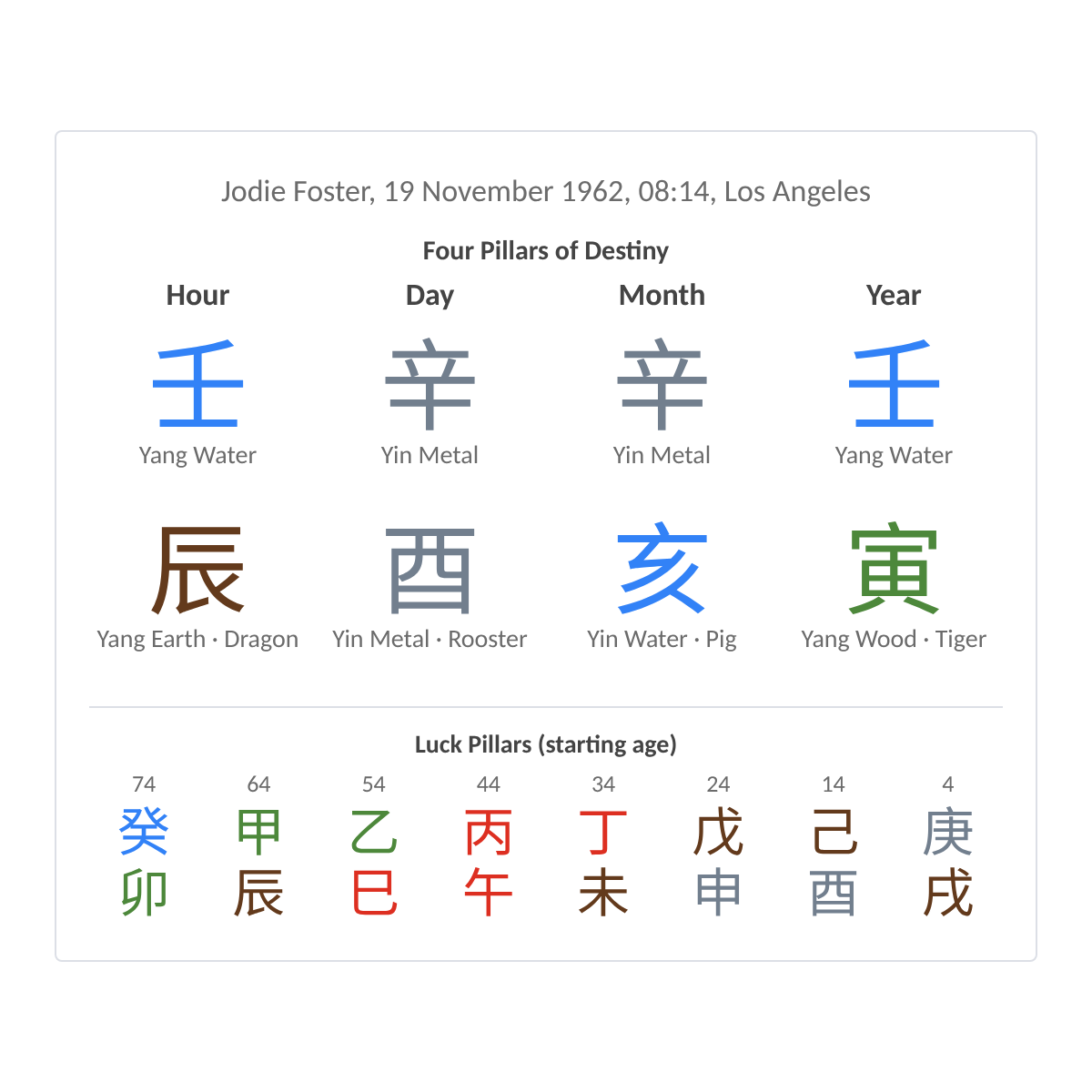
Yin Metal—Jodie Foster. The actress was born on a 辛酉 day and in the Hour of the Dragon. Yin Metal is a piece of jewelry, and such people are often very beautiful. Foster’s chart contains a lot of Water—Output, which gives her acting talent: Yin Metal “shines” when washed by water.
Element correspondences
| Correspondence | Metal |
|---|---|
| Season | Autumn |
| Direction | West |
| Color | White, metallic shades |
| Shape | Round |
| Produces | Water |
| Produced by | Earth |
| Controls | Wood |
| Controlled by | Fire |
These correspondences are used in both BaZi and feng shui. For example, if Metal is useful for a person, it can be introduced through color, shape, or direction at home and at work.
A lot or a little of the element in the chart
A lot of Metal in a chart brings willpower, a sense of justice, and the ability to make decisions and see things through. Excess Metal can manifest as rigidity and harshness. If there is little Metal, the person may find it difficult to say “no” and maintain discipline.
It is important to remember that “a lot” does not mean “good,” and “a little” does not mean “bad.” Everything depends on the strength of the Day Master and which elements are useful to it. There is a big difference between Metal born in autumn and Metal born in summer, when Fire melts it.
Metal and careers
People often succeed in work connected with the strongest element in their chart. If Metal dominates the chart, consider fields such as finance and banking, mechanical engineering, metallurgy, metal mining, jewelry making, law, the military and law enforcement, and technology.
Metal and date selection
Every day has its own Stems and Branches, and therefore its own elements. A day that brings an element useful to you supports a new undertaking. A day that clashes with your chart does the opposite. That is why date selection on the site takes your BaZi chart into account: check your personal stars by date of birth or open the Personal Calendar. For a specific undertaking, use the auspicious date search.
Frequently asked questions
Is it bad if there is no Metal in my chart?
Not necessarily. A missing element is a feature of the chart, not a verdict. If Metal is useful to you, you can introduce it through your surroundings and look forward to periods when it arrives in the Luck Pillars or individual years.
My Day Master is Metal. Does that mean Metal is useful to me?
Not always. A strong Day Master usually benefits from elements that weaken it, while a weak one benefits from those that support it. This is determined by looking at the entire chart.
Views: 1