
Year, Month, and Day in BaZi: The Solar Calendar and Li Chun
Chinese people still use two calendars: the lunar calendar for holidays and everyday life, and the solar calendar for agriculture, feng shui, and BaZi. A BaZi chart is based on the solar calendar. Let’s look at how it counts years, months, and days, and why people born in late January or early February often identify their BaZi year incorrectly.
Lunar and solar calendars
A lunar month lasts from one new moon to the next—29 or 30 days. About once every three years, a thirteenth month is added to the lunar year. That’s why Lunar New Year falls on different dates between January 20 and February 20.
The solar calendar is based on the Sun’s movement. The year is divided into 24 solar terms, each lasting about 15 days and beginning around the same dates in our calendar each year. It is sometimes called the Xia calendar, after an ancient dynasty. Lunar and solar months almost never coincide, and BaZi always uses the solar calendar.
The Year Pillar: Li Chun marks the boundary
The solar year begins on Li Chun (立春), “Beginning of Spring,” which falls on February 3–5. In BaZi, the Year Pillar is calculated from this date—not from Lunar New Year or January 1.
The difference is clear in the example of 1990. Lunar New Year fell on January 27, while Li Chun fell on February 4.
| Date of birth | According to the lunar calendar | In BaZi |
|---|---|---|
| February 2, 1990 | Already the Year of the Horse | Still the Year of the Snake, 己巳 |
| February 6, 1990 | Year of the Horse | Year of the Horse, 庚午 |
Popular horoscopes usually count the year from Lunar New Year, so someone born on February 3, 1990, may consider themselves a Horse. In BaZi, they are a Snake, and their pillars and Luck Pillars are calculated from the Year of the Snake.
Example: Two boys born on February 3, 2026
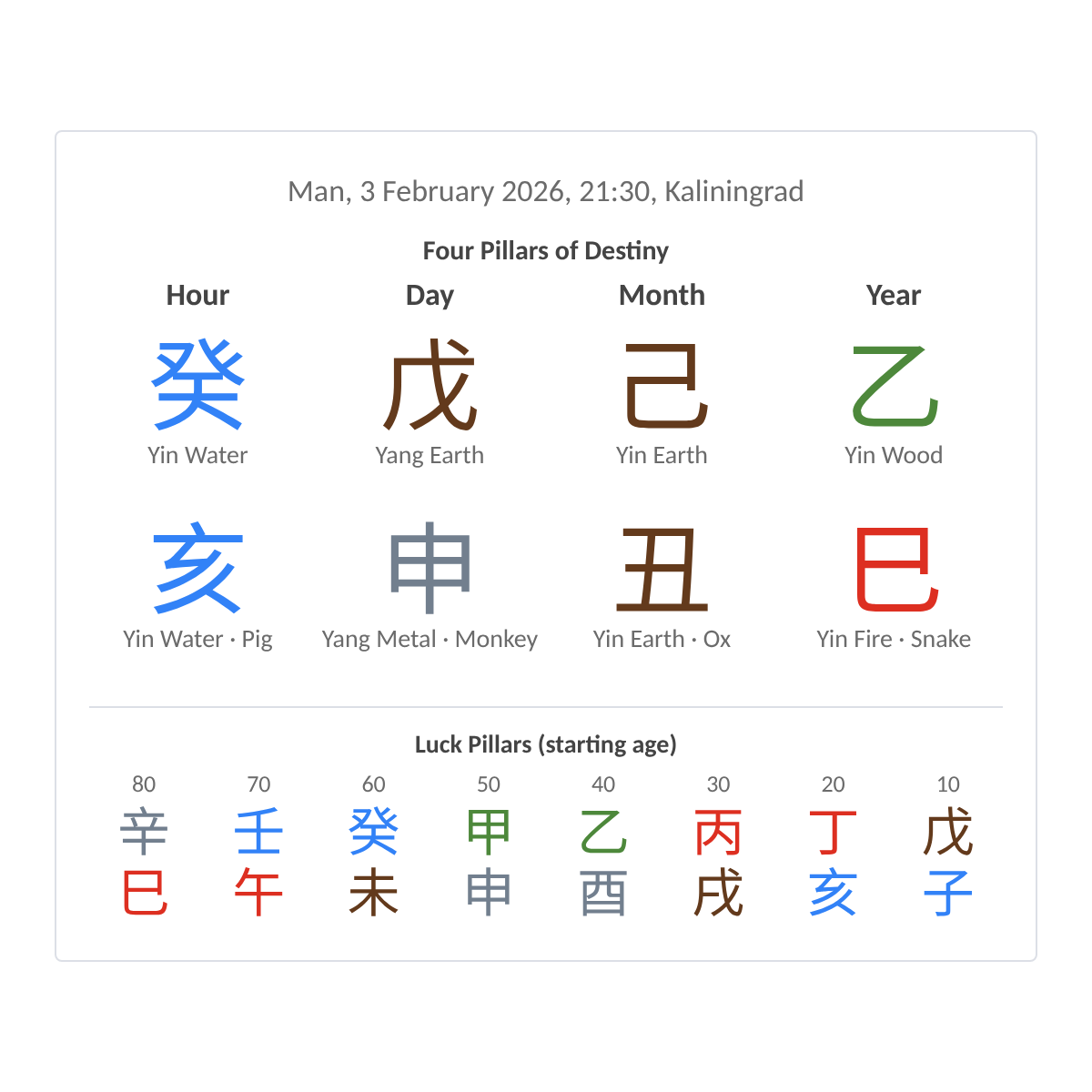
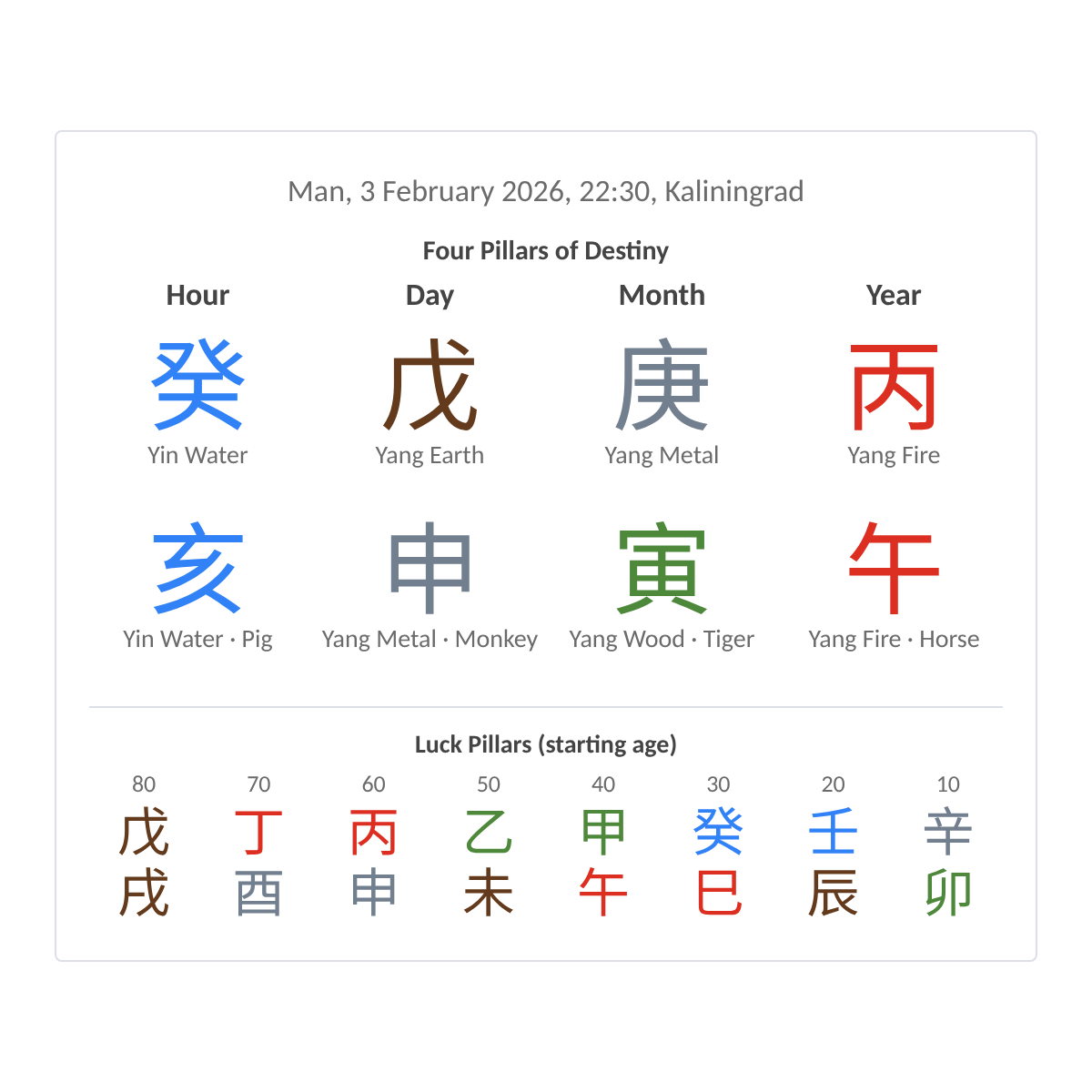
In 2026, Li Chun—the beginning of spring and of the new BaZi year—occurred on February 3 at 20:01 UTC, or 22:01 Kaliningrad time. Imagine two boys born in Kaliningrad that same evening: one at 21:30, half an hour before Li Chun, and the other at 22:30, half an hour after. Both were born on the same day and even in the same Chinese hour—the Hour of the Pig. But their BaZi charts are different.
| Pillar | 21:30 (before Li Chun) | 22:30 (after Li Chun) |
|---|---|---|
| Year | 乙巳 — Yin Wood, Snake | 丙午 — Yang Fire, Horse |
| Month | 己丑 — Yin Earth, Ox (winter) | 庚寅 — Yang Metal, Tiger (spring) |
| Day | 戊申 — Yang Earth, Monkey | 戊申 — same |
| Hour | 癸亥 — Yin Water, Pig | 癸亥 — same |
| Luck Pillars | Move backward: 戊子, 丁亥, … 丙戌, starting at age 10 | Move forward: 辛卯, 壬辰, … 癸巳, starting at age 10 |
What changed:
- Year. The first boy is still a Snake according to the Chinese calendar; the second is already a Fire Horse, even though Lunar New Year is still two weeks away, on February 17.
- Month and season. The first was born in winter, in the Month of the Ox; the second was born in spring, in the Month of the Tiger. This matters for their shared Day Master, Yang Earth (戊): the Tiger’s spring Wood represents Power, so the boys will have different chart strengths and useful elements.
- Luck Pillars. For the boy born in a Yin year, 乙, they move backward; for the boy born in a Yang year, 丙, they move forward. A half-hour difference results in very different ten-year periods.
- The Day and Hour Pillars are the same: they are not determined by the solar terms.
The takeaway is simple: if you were born in early February or on another day when a solar term changes, it’s important to know your birth time to the minute. The BaZi calculator on our site automatically accounts for the exact time of the solar term and the time zone.
The Month Pillar: 12 solar months
Twelve of the 24 solar terms mark the start of the months. The Earthly Branch of each month stays the same from year to year: the first month is always the Tiger, the second the Rabbit, and so on.
| Month | Branch | Begins with the solar term | Approximate date |
|---|---|---|---|
| 1 | 寅 Tiger | Li Chun 立春 | February 3–5 |
| 2 | 卯 Rabbit | Jingzhe 惊蛰 | March 5–6 |
| 3 | 辰 Dragon | Qingming 清明 | April 4–6 |
| 4 | 巳 Snake | Lixia 立夏 | May 5–7 |
| 5 | 午 Horse | Mangzhong 芒种 | June 5–7 |
| 6 | 未 Goat | Xiaoshu 小暑 | July 6–8 |
| 7 | 申 Monkey | Liqiu 立秋 | August 7–9 |
| 8 | 酉 Rooster | Bailu 白露 | September 7–9 |
| 9 | 戌 Dog | Hanlu 寒露 | October 8–9 |
| 10 | 亥 Pig | Lidong 立冬 | November 7–8 |
| 11 | 子 Rat | Daxue 大雪 | December 6–8 |
| 12 | 丑 Ox | Xiaohan 小寒 | January 5–7 |
The Month’s Heavenly Stem depends on the Year’s Stem. In 甲 and 己 years, the Month of the Tiger is 丙寅; in 乙 and 庚 years, it is 戊寅; in 丙 and 辛 years, it is 庚寅; in 丁 and 壬 years, it is 壬寅; and in 戊 and 癸 years, it is 甲寅. The Stems then continue in order.
Precision matters near the beginning of a month. In 1990, Jingzhe occurred at night on March 6, Moscow time. Someone born on March 4 has the Month Pillar 戊寅, while someone born on March 8 has 己卯. You can find the exact time each solar term begins in the 24 Solar Terms section.
The Day Pillar: the 60-day cycle
Days follow a repeating cycle of 60 Stem-Branch combinations: 甲子, 乙丑, … 丙寅, continuing through 癸亥 before the cycle starts again. This count is not tied to months or years, so the easiest way to find the Day Pillar is to use a calendar table or calculator.
There is one detail to consider: when the new day begins. The Hour of the Rat lasts from 11:00 p.m. to 1:00 a.m. Some schools consider the new day to begin at 11:00 p.m., while others use midnight. So if you were born between 11:00 p.m. and midnight, different calculators may give you different Day Pillars—and therefore different Day Masters. The calculator on our site treats midnight as the start of a new day.
How this relates to date selection
The same rules are used to calculate each day in the Chinese almanac: every day also has Year, Month, and Day Pillars. By comparing them with the pillars in your BaZi chart, the site identifies your personal stars and marks days that clash with your chart. That is how the Personal Calendar works. Generate your chart using the BaZi calculator—it automatically accounts for Li Chun and the solar terms.
Frequently asked questions
If I was born on Li Chun, which year applies to me?
It depends on the time. Li Chun occurs at a specific time of day. Those born before it belong to the old year; those born after it belong to the new year.
What is the lunar calendar used for, then?
It is used for holidays, folk traditions, and some methods such as Zi Wei Dou Shu. BaZi and date selection based on the Tong Shu use the solar calendar.
Why doesn’t the month in my chart match the usual calendar month?
Because a Chinese month doesn’t begin on the first of the month; it begins with a solar term, usually around the 4th–8th. People born near the beginning of a month often fall in the previous Chinese month.
Views: 1