
Wood in BaZi: Yang and Yin Wood in the Chart
Wood is one of the five elements on which both BaZi and feng shui are based. In a BaZi chart, Wood can appear in the Heavenly Stems and the Earthly Branches, or it can be the Day Master—in which case it describes the person themselves. Let’s explore what Wood means in a chart, how its Yang form differs from its Yin form, and what it means when there is a lot or very little of this element.
Which signs belong to the Wood element?
Among the Heavenly Stems, these are 甲 Jia (Yang Wood) and 乙 Yi (Yin Wood). Among the Earthly Branches, they are 寅 Tiger and 卯 Rabbit. Generate your chart in the BaZi calculator, find these signs, and count how many times this element appears.
Yang and Yin forms
甲 Jia, Yang Wood is the trunk and roots of a large tree. It seems motionless, yet it grows slowly and persistently, pushing through the earth. This gives rise to firmness, stability, and loyalty to principles.
乙 Yi, Yin Wood is branches, leaves, grass, and flowers. It is soft, flexible, and constantly renewing itself: leaves fall in autumn and grow again in spring. This gives rise to adaptability and the ability to find alternative paths.
Examples: Yang and Yin Wood
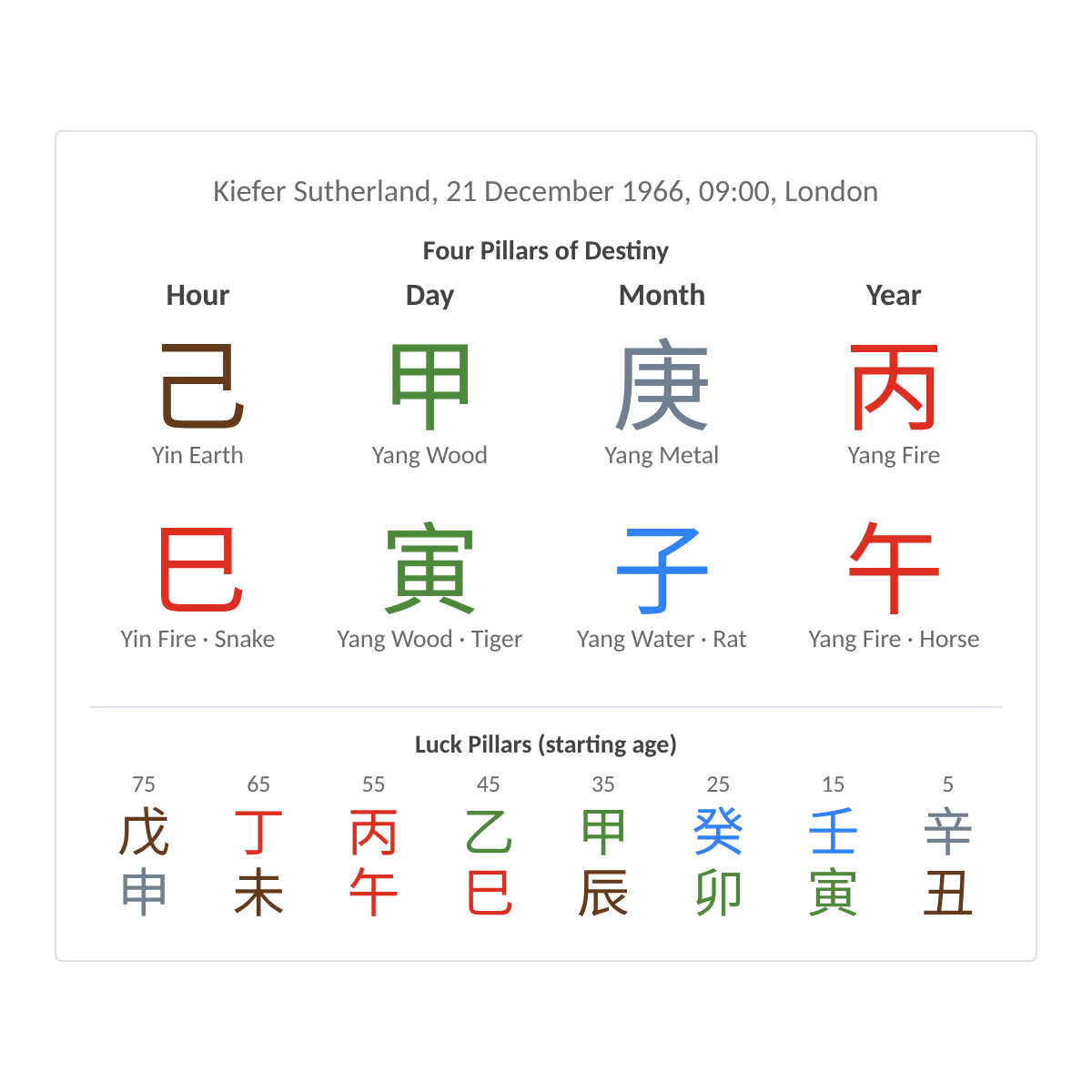
Yang Wood—Kiefer Sutherland. The actor was born on a 甲寅 day: Yang Wood sits on the Tiger, its own root, while the winter Month of the Rat nourishes it with Water. This is a trunk with deep roots—straight, persistent, and inflexible.
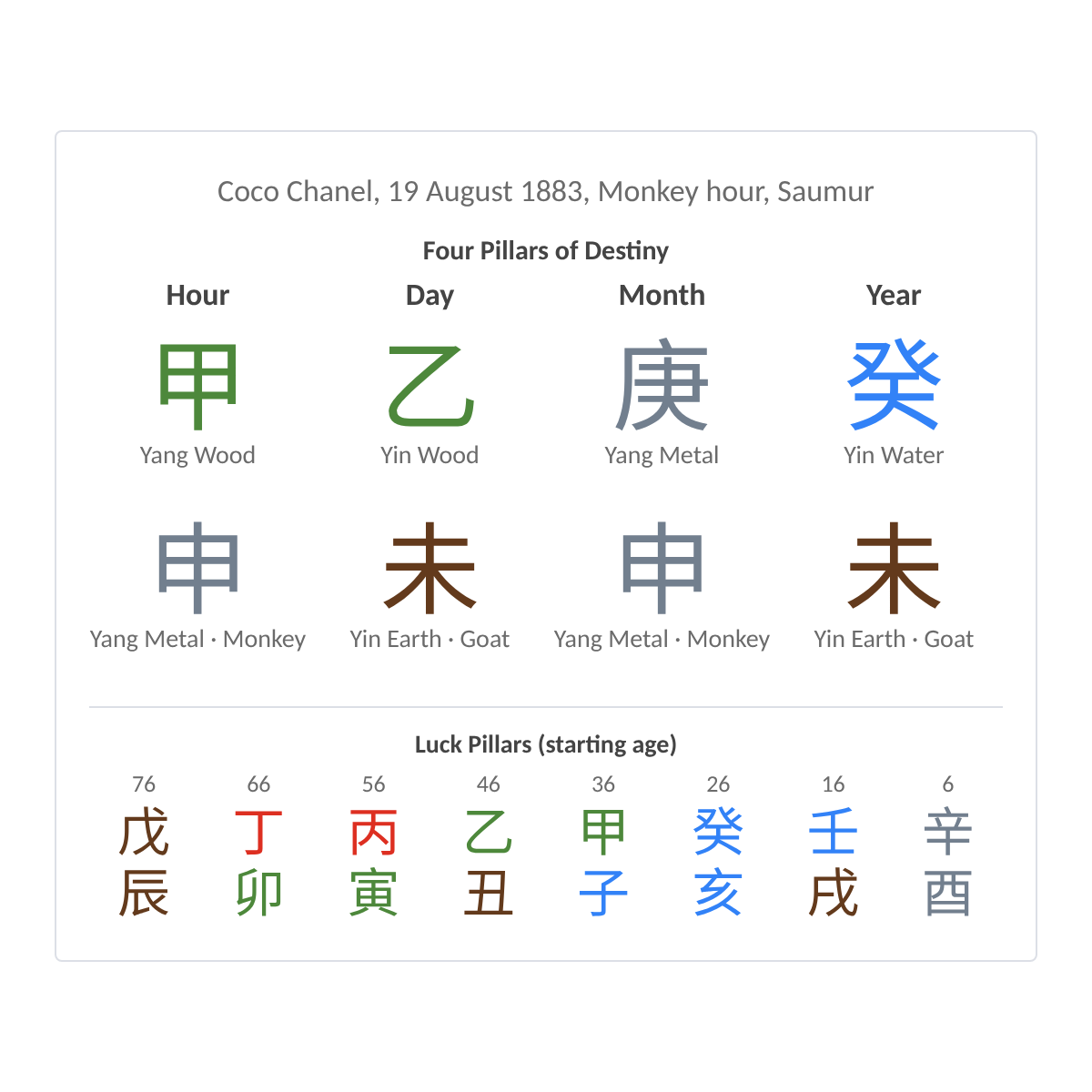
Yin Wood—Coco Chanel. Chanel was born on an 乙未 day, in the autumn Month of the Monkey, when Metal is strong. Yin Wood is a vine that clings to a support, and for Chanel that support was Yang Metal 庚 in the Month Pillar, forming a combination with her Day Master. Flexibility and adaptability helped her rise from an orphanage to worldwide fame. Metal also represented a man for her; in her life, this manifested as powerful male patrons, although she never married.
Element correspondences
| Correspondence | Wood |
|---|---|
| Season | Spring |
| Direction | East |
| Color | Green |
| Shape | Elongated, vertical |
| Produces | Fire |
| Produced by | Water |
| Controls | Earth |
| Controlled by | Metal |
These correspondences are used in both BaZi and feng shui. For example, if Wood is useful for a person, it can be introduced through color, shape, or direction at home and at work.
A lot or a little of the element in the chart
A person with a lot of Wood in their chart is usually goal-oriented, enjoys growth and development, and is drawn to knowledge and people. If there is too much Wood, stubbornness and an unwillingness to compromise emerge. If there is almost no Wood, the person may lack flexibility and initiative.
It is important to remember that “a lot” does not mean “good,” and “a little” does not mean “bad.” Everything depends on the strength of the Day Master and which elements are useful to it. There is a big difference between Wood born in spring, when it is at full strength, and Wood born in late autumn, when it is very weak.
Wood and careers
People often succeed in work connected with the strongest element in their chart. If Wood dominates the chart, consider fields such as education, publishing, working with plants and gardens, woodworking, furniture, textiles, paper, and herbal medicine.
Wood and date selection
Every day has its own Stems and Branches, and therefore its own elements. A day that brings an element useful to you supports a new undertaking. A day that clashes with your chart does the opposite. That is why date selection on the site takes your BaZi chart into account: check your personal stars by date of birth or open the Personal Calendar. For a specific undertaking, use the auspicious date search.
Frequently asked questions
Is it bad if there is no Wood in my chart?
Not necessarily. A missing element is a feature of the chart, not a verdict. If Wood is useful to you, you can introduce it through your surroundings and look forward to periods when it arrives in the Luck Pillars or individual years.
My Day Master is Wood. Does that mean Wood is useful to me?
Not always. A strong Day Master usually benefits from elements that weaken it, while a weak one benefits from those that support it. This is determined by looking at the entire chart.
Views: 1