
The 10 Heavenly Stems in BaZi: Meaning and Character
There are ten Heavenly Stems: two for each of the five elements, one Yang and one Yin. Chinese masters describe each Stem through a natural image: a tree, the sun, a mountain, a river. This image helps us understand the character of a person who has that Stem in the Day Pillar, meaning it is their Day Master.
How the Stems follow one another
The Stems move in a cycle, like stages of a single natural process. Wood grows and feeds Fire. As Fire burns down, it turns to ash, which is Earth. Ore, which is Metal, is born within Earth. Moisture condenses on cold metal, which is Water, and it nourishes Wood again. Within each element, the Yang stage passes into the Yin stage: a bright flame becomes smoldering embers, and a mighty trunk becomes young shoots.
Here is how this looks in a chart, using Nicole Kidman’s chart as an example. The top row contains the four Heavenly Stems: 丁 in the Year, 丙 in the Month, 乙 in the Day, and 壬 in the Hour. The bottom row contains the four Earthly Branches: Goat, Horse, Rabbit, and another Horse. The Day Stem 乙, Yin Wood, is her Day Master.
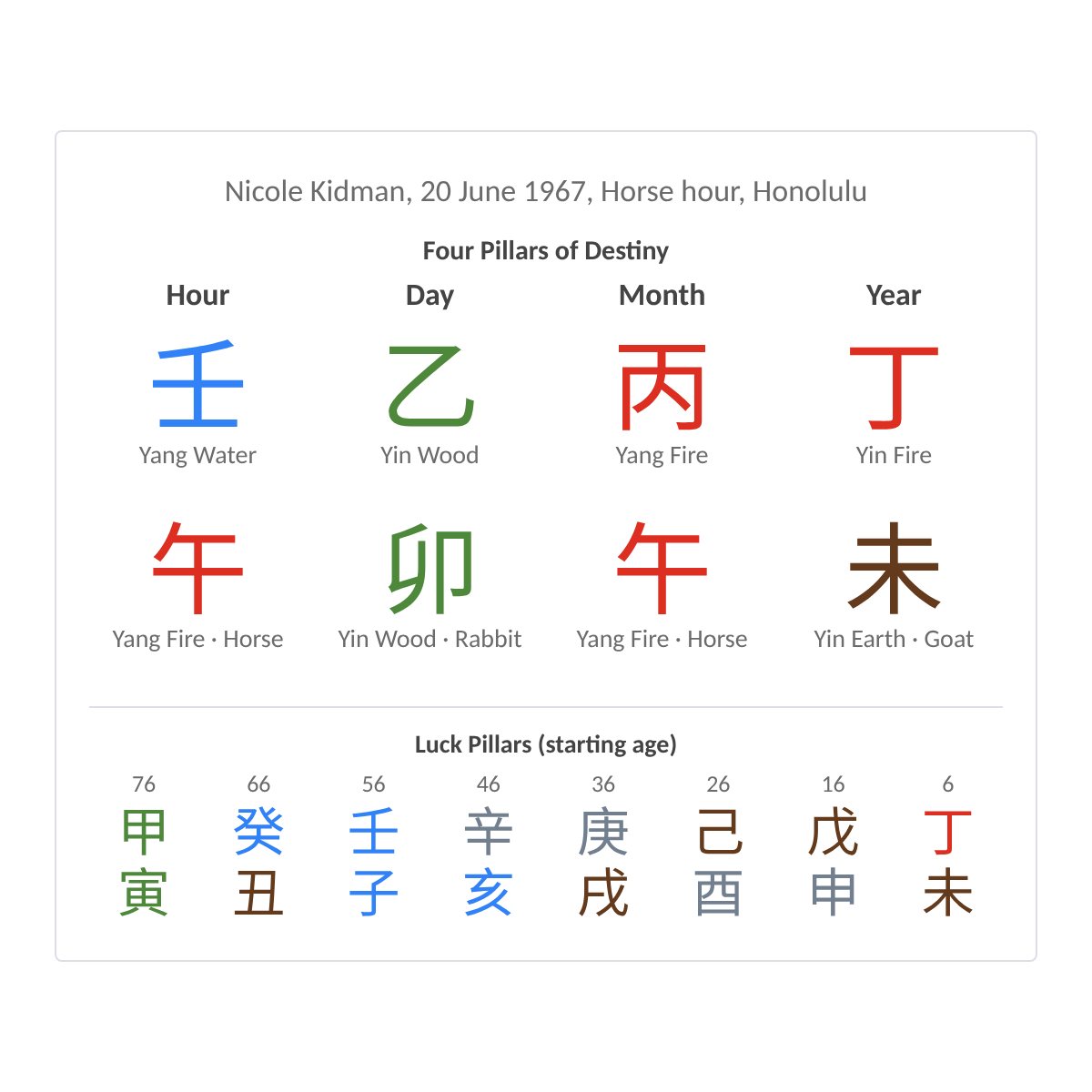
Wood: 甲 and 乙
甲 Jia, Yang Wood is a large tree with a strong trunk and deep roots. This person is firm, reliable, and loyal to their principles. The downside is stubbornness: under strong pressure, they are more likely to break than to bend.
乙 Yi, Yin Wood is grass, flowers, and climbing plants. This person is flexible, intelligent, and adapts well. Like a vine reaching toward the light along a wall or a large tree, they know how to find a way around obstacles, but sometimes depend too much on the support of others.
Fire: 丙 and 丁
丙 Bing, Yang Fire is the sun. This person is open, warm, and generous. They speak directly, quickly catch fire with new undertakings, and easily connect with people. Because of their impatience, they are sometimes misunderstood.
丁 Ding, Yin Fire is a candle, a lantern, the warmth of smoldering embers. This person is sensitive, thinks deeply, and is often creative. Their flame flickers: they can be emotional and impressionable, and it is important for them to learn to rest.

Earth: 戊 and 己
戊 Wu, Yang Earth is a mountain. This person is solid, reliable, and generous, someone you can lean on. Like a mountain, they find it hard to change quickly: they can be conservative and slow to get moving.
己 Ji, Yin Earth is the fertile soil of a garden. This person is caring, flexible, and intelligent, with a strong nurturing instinct. Sometimes they are too easily influenced by others, so it is important for them to choose their surroundings wisely.
Metal: 庚 and 辛
庚 Geng, Yang Metal is ore, steel, a blade. This person is decisive, direct, and loyal to friends, with natural leadership qualities. They act quickly, dislike wasting time on doubts, and do not accept defeat.
辛 Xin, Yin Metal is precious metal, jewelry. This person is elegant, charming, and attracts attention. They value beauty and comfort and care greatly about their reputation.
Water: 壬 and 癸
壬 Ren, Yang Water is a river, the sea. This person is energetic and impulsive, learns quickly, and readily accepts new things. Like a current, they do not like to look back, but they can be careless.
癸 Gui, Yin Water is dew, rain, mist. It is the most Yin of all the Stems. This person is gentle, patient, and accepts people as they are. Yet they are not weak: as a drop wears away stone, they achieve their goals gradually.
An important caveat
A description of the Day Master is only the first, most general level of analysis. Character is strongly influenced by the other characters in the chart, the season of birth, and the strength of the Day Master. Two people with the same Day Stem can be completely different.
Heavenly Stems and date selection
Stems appear not only in a birth chart but also in every day of the calendar. When the day’s Stem forms a combination or conflict with the Stems in your chart, it affects how favorable that day is for you. That is why dates on the site are checked against your BaZi chart. Generate your chart in the BaZi calculator and open the Personal Calendar, which already takes your personal stars into account.
Frequently asked questions
Which Stem is the best?
There is no such thing. Each Stem has its own strengths and vulnerabilities. What matters more is how well the Stem is balanced by the rest of the chart.
Why are the Stems called “Heavenly”?
They describe time and govern the upper, “heavenly” row of the chart, as opposed to the Earthly Branches in the lower row. The Heavenly Stems show what is visible on the outside of a person.
Do I need to learn the Chinese characters?
Not necessarily, but it is useful. There are only twenty-two characters in total: ten Stems and twelve Branches. Knowing them makes the chart easier to read and remember.
Views: 1