
Hour Stars in Date Selection
Anyone who has ever chosen auspicious dates using the Chinese calendar knows that besides selecting a good day, it is also important to pick a favorable hour. Our "Feng Shui Fortune Calendar" allows you to do this with ease. After choosing a day, you can scroll down the page to see the "Positive Hour Stars" and "Negative Hour Stars" for each hour. These include Day Wealth (日禄), Harmonious Hour (日合), Road Emptiness (截路空亡), Heavenly Punishment (天刑), and others.
These stars are determined by different rules, since the system of selecting hours in Ze Zhi Xue (择日学) system includes several methods. Here, we will talk about the "Constant Pattern Method" or "Fixed Bureau Method" (定局法).
This method for identifying auspicious and inauspicious hours on any given day is used in the famous Tong Shu almanac (通书). The image below shows standard Tong Shu pages detailing auspicious and inauspicious stars for each hour across all days of the 60-day cycle. Auspicious stars are marked in red, while inauspicious ones are in black.
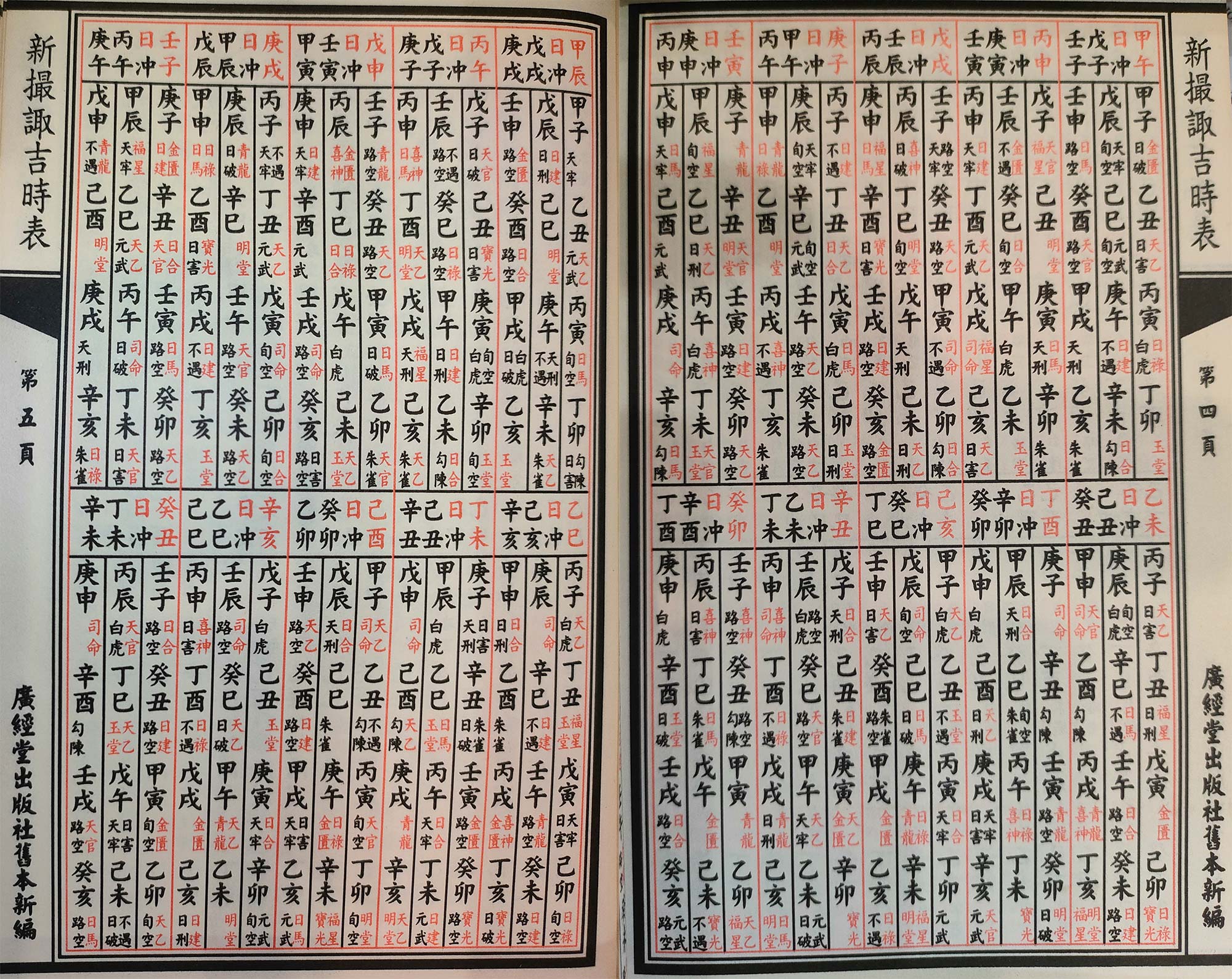
Tong Shu pages with hour stars.
The method is based on 12 fixed signs or "stars," such as Qinglong (Green Dragon), Mingtang (Bright Hall), Jingui (Golden Chest), and others. Unlike other systems where stars and signs may vary, here each star arrives on a specific day at a strictly defined hour.
But what are the principles for determining these hours? The Tong Shu only presents them in a table without any explanations of their origins. Chinese metaphysics usually has everything very clearly laid out, with calculations following logical schemes. However, my attempts to understand the Tong Shu pages and find any logic in how signs are arranged by hour were unsuccessful.
In researching this, I found that the Tong Shu tables, compiled many years ago, show only some of the stars – just two per hour as you can see in the picture above. I assume this is because a printed page has limited space, and only two stars per hour could fit in the columns. Abbreviations in popular references are a typical Chinese approach. I am sure specialists know the complete tables and use those.
Interestingly, the well-known book "The Art of Date Selection," used by many contemporary specialists, contains only a translation of the Tong Shu tables with the same two stars per hour and provides no explanation of the principles behind choosing those hours. This is not surprising because the authority of Tong Shu is so great that few dare to alter the ancient tables or claim errors within them. However, a close look reveals some inconsistencies.
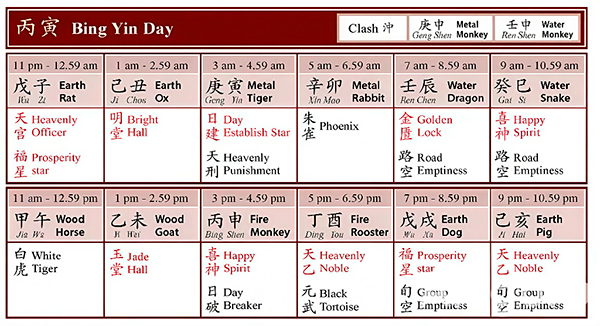
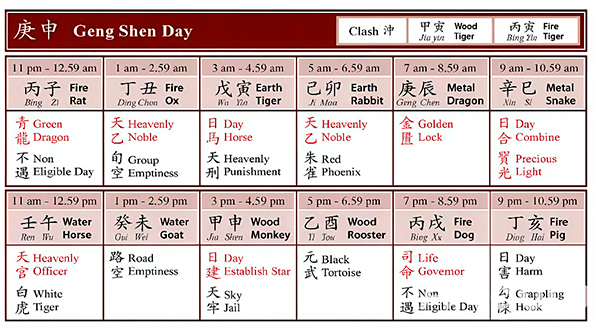
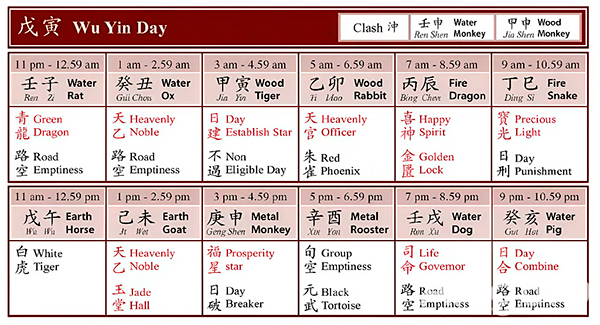
For example, well-known stars like "Day Punishment" or "Day Breaker" sometimes appear on the list but are missing in cases where they clearly should be. In the day 戊寅 (Earth Tiger), "Day Punishment" should be present during the hours forming "Fire Punishment", i.e., 申 and 巳 hours. Yet the table shows "Day Punishment" only at 巳 while 申 has "Day Breaker," which the creators probably considered more important. But in the day 丙寅 (Fire Tiger), "Day Punishment" is absent in both 申 and 巳 hours (instead, it shows "Group Emptiness"). For the day 庚申 (Metal Monkey), "Day Punishment" should be at 巳 and 寅 hours but is missing in both. Also, in the 寅 hour of 庚申 day, where clearly "Day Breaker" should be, it is absent and replaced by "Heavenly Punishment." I can only explain these omissions by the fact that in old times, Tong Shu creators had to place all days and hours on just a couple of pages and simply "left out" some stars. Anyway, specialists know how to find them, even if they are not included in the popular book.
My online search for algorithms to calculate these stars did not quickly find any system. I had to conduct a thorough investigation and uncover all the details...
It turned out that the "Constant Pattern Method" (定局法) is a fundamental and strict classical Chinese chronomancy system, based on rules from the "Notes from the Jade Box" (玉匣记 Yù Xiá Jì), an ancient Chinese book traditionally attributed to the Daoist sage Xu Zhengzong (道士许真人) of the Eastern Jin era. The main feature of this method is the rigid attachment of each sign or "star" to a specific hour on a specific day. Simply put, the star of a particular hour is determined through the pair Earthly Branch of the day and Earthly Branch of the hour.
Now let's introduce the system of 12 signs. In the text it is called (十二黑黄道, Shi Er Hei Huang Dao). This can be translated as “The Twelve Black and Yellow Paths.” The Yellow Path (黄道 Huang Dao) represents auspicious signs; the Black Path (黑道 Hei Dao) represents inauspicious signs. In the «Feng Shui Fortune Calendar," we call all these signs "stars" since that is the term commonly used in modern Chinese metaphysics popular in the West. Of course, these are not actual stars but specific energies corresponding to the hours.
Below are the 12 "stars" with their meanings:
|
No. |
Sign |
Name (English) |
Meaning |
|
1 |
青龙 |
Green Dragon |
The most auspicious — symbol of luck, growth, and support from powerful forces |
|
2 |
明堂 |
Bright Hall |
Very good sign, promises success and official recognition |
|
3 |
天刑 |
Heavenly Punishment |
Inauspicious, foretells legal disputes |
|
4 |
朱雀 |
Red Phoenix |
Inauspicious, symbol of conflict and quarrels |
|
5 |
金匮 |
Golden Chest |
Auspicious, brings success in financial affairs |
|
6 |
天德 |
Heavenly Virtue |
Protection by higher powers and problem resolution |
|
7 |
白虎 |
White Tiger |
Very inauspicious, symbolizes danger and injuries |
|
8 |
玉堂 |
Jade Hall |
Auspicious, promises harmony and creative success |
|
9 |
天牢 |
Heavenly Jail |
Inauspicious, portends restrictions and misfortune |
|
10 |
玄武 |
Black Tortoise |
Inauspicious, associated with deceit and hidden dangers |
|
11 |
司命 |
Life Governor |
Auspicious, grants health and good fortune |
|
12 |
勾陈 |
Grappling Hook |
Inauspicious, symbol of delays and complicated situations |
The table above shows the fixed cyclic sequence of hour stars every day. The question is which hour on a given day corresponds to the first hour of the Green Dragon (青龙 Qinglong). It can be either the Rat hour or any other hour.
The calculation method for the Tong Shu "Constant Pattern Method", which I discovered through my research, will be presented in a separate article It turned out to be less complicated and confusing than it seemed initially. It turns out that the sign of a particular hour rigidly depends on the pair of Earthly Branches of the day and the hour, but not on the year or month. This makes the method convenient and popular for selecting times for important events — from weddings to store openings.
Views: 19